
Why Scenario-Based Learning Outperforms Traditional Training
Why judgment beats memorization when the pressure is real

In this article:
Most workplace training still follows a familiar pattern: present information, quiz for recall, and hope it translates into performance. It’s comfortable and fast, and it creates the illusion of effectiveness, since learners can usually repeat back what they just heard. Unfortunately, when the pressure is on, a difficult customer, a safety hazard, a tense coaching conversation, people don’t rely on what they memorized. They fall back on habits.
Key Takeaways
- Traditional “tell-and-test” training teaches knowledge, not judgment, which is why people fall back on habits under real pressure instead of what they memorized.
- Scenario-based learning works because it mirrors how adults learn: through experience, decisions, and reflection, not information alone.
- Scenarios belong well beyond eLearning, showing up just as naturally in onboarding, coaching, and leadership development.
Where Traditional Training Falls Short
Learners can often recall information minutes after hearing it and pass a quiz, but that recall doesn’t reliably translate to real-world application. This is the core failure of the tell-and-test model: it teaches knowledge, not judgment. Organizations don’t need employees who can pass a quiz. They need employees who can make good decisions, and scenario-based learning is built for exactly that.
How Adults Learn
Adults don’t learn best by being told what to do. They learn by doing, deciding, and reflecting, the same processes they rely on every day at work, a core piece of adult learning theory. Scenario-based learning taps directly into that process. Instead of asking learners to recall facts, it places them inside realistic situations and asks them to make choices, see consequences, and adjust their thinking.
Scenarios support the way adults naturally learn: through experience, problem-solving, and reflection. That’s why scenario-based learning tends to outperform traditional training. It mirrors real work instead of just describing it.
Four Benefits of Scenario-Based Learning
Scenario-based learning rests on four specific mechanisms grounded in the same instructional design process that helps determine whether any training format earns its place, well beyond simply being more engaging than a slide deck.
It reflects the realities of the job
People pay attention when training feels relevant. Scenarios recreate the pressures, nuances, and decisions employees face daily, giving them a safe place to practice before they encounter those moments in real life
It builds judgment, not memorization
Traditional training teaches what to do. Scenarios teach how to think. By presenting realistic choices with tradeoffs, scenarios strengthen the decision-making skills employees need in complex situations.
It encourages reflection and insight
Adults bring habits, assumptions, and past experiences to their work. Scenarios surface those patterns and create space for reflection, the moment where learning sticks
It increases emotional engagement
People remember what feels meaningful. Scenarios show how decisions affect outcomes, creating emotional resonance that makes learning more memorable and more likely to be applied.
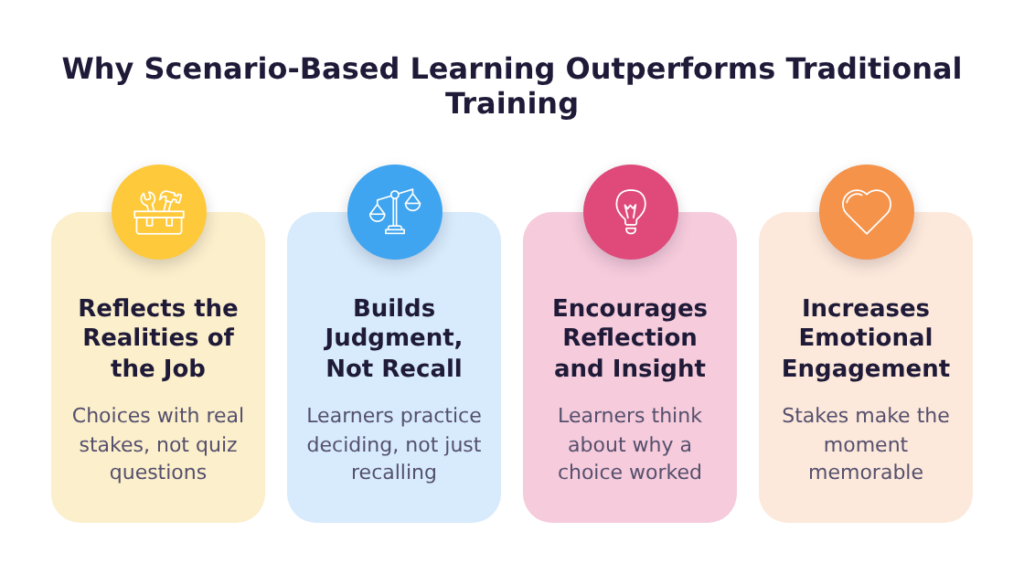
Together, these mechanisms build training that does more than inform people. It changes how they perform.
Opportunities for Scenario Based Learning
One of the biggest misconceptions is that scenarios belong only in eLearning. In reality, they show up everywhere:
- Onboarding: help new hires practice common challenges before they encounter them.
- Team meetings: use weekly “scenario spotlights” to reinforce expectations.
- Coaching conversations: guide employees through difficult decisions, building on the same coaching conversation skills managers already need.
- Leadership development: strengthen judgment in complex interpersonal situations.
- Safety and compliance: simulate hazards before employees face them.
- Digital learning libraries: offer quick practice moments employees can revisit anytime, often as part of a broader approach to modern eLearning.
When scenarios become part of everyday learning, they help build a culture of thoughtful decision-making. This is how organizations shift from knowledge-based training to performance-based development.
Where Scenarios Are Needed Most
Most teams have a handful of recurring moments where good judgment breaks down: new hires who hesitate even after training, experienced employees who quietly deviate from the “correct” process because it doesn’t hold up in practice, or a customer complaint, safety incident, or missed deadline that keeps tracing back to the same kind of situation. Those recurring moments are the raw material for a good scenario, whether that becomes a full scenario built to change behavior or a refinement to one you already have.
Building Strong Scenarios
Good scenarios come from a strong understanding of what separates a good decision from a bad one, what goes wrong when someone chooses incorrectly, and the pressure someone is under when the decision has to be made. Those factors make the difference between a scenario that feels authentic and one that reads like a textbook example.
Two groups usually hold the pieces that make a scenario real. SMEs carry the judgment, the instincts built from years in the role, the sense of what a good call looks like even when they can’t fully explain why. Frontline employees carry something different: the day-to-day friction, the moments where the official process breaks down, the workarounds nobody wrote into a manual. A scenario built from only one of those sources tends to feel incomplete, either technically accurate but disconnected from how the work happens, or realistic in feel but missing the judgment that makes the decision matter.
Getting both data points usually means combining two things: watching the work directly and structured conversations with subject matter experts about what the best performers do. Once the information is gathered, a strong, collaborative relationship between the ID and the SME usually produces the best scenarios. The SME helps clarify the work, while the ID molds the scenario into something that will resonate with learners.
Final Thoughts
Traditional training teaches people what to know. Scenario-based learning teaches them how to think under pressure, and that distinction is what shows up the moment a real decision is on the line. The format works because it mirrors how adults learn, through doing and reflecting rather than just hearing, and that holds whether the scenario lives inside a course, a coaching conversation, or a team meeting.
Ready to find the moments in your training where judgment matters more than memorization? Explore our instructional design consultant services or schedule a free consultation with one of our designers to talk through your training goals.