
Strengthening Collaboration Between SMEs and IDs: Five Common Challenges
Five common stumbling blocks and how to avoid them
| September 14, 2026 | Instructional Design, SME Collaboration |

In this article:
Subject Matter Experts (SMEs) bring deep, hard‑earned knowledge to the table but the way they think about their field doesn’t always match how learners take in new information. Instructional designers (IDs) work to translate that expertise into clear, usable learning experiences. When the two roles work well together, the results are fantastic. But the partnership can also hit a few familiar bumps along the way. The good news is that most of those friction points are predictable and with a few intentional strategies, they’re easy to avoid.
Key Takeaways
- Subject Matter Experts naturally gravitate toward depth and detail. Instructional designers must filter that complexity into the high‑value skills learners can absorb without cognitive overload.
- Experts operate from an advanced mental map built through years of experience. Instructional designers must translate that map into the sequenced, beginner‑friendly pathways new learners can use.
- SMEs tend to default to explanation over demonstration, describing what they know rather than showing what the work actually looks like. Instructional designers close that gap by asking SMEs to narrate a real task step by step and to point to concrete examples of good, bad, and almost-right work.
Where Collaboration Breaks Down
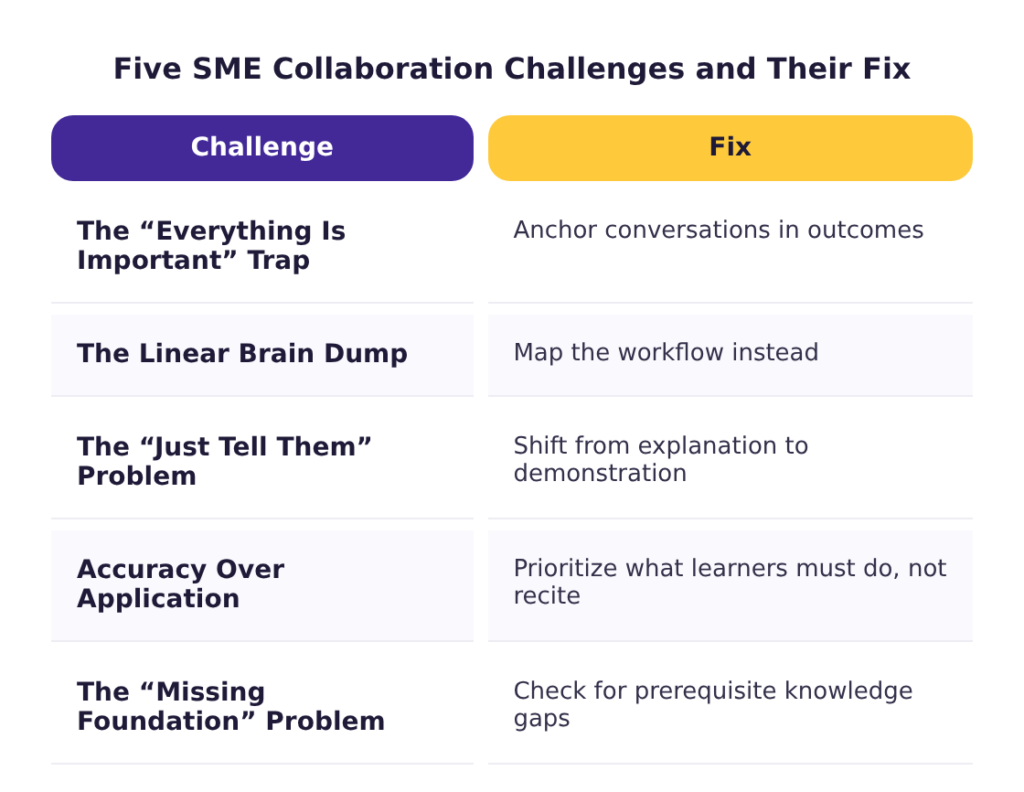
Most friction between Subject Matter Experts (SMEs) and Instructional Designers (IDs) doesn’t come from a lack of goodwill on either side. It comes from an SME who’s spent years learning to see every detail as necessary, paired with an ID whose job is to cut most of those details away. Neither one is wrong. They’re just optimizing for different things. There are five stumbling blocks that commonly arise at the intersection of these intentions.
Challenge 1: The “Everything Is Important” Trap
SMEs have spent years absorbing the complexity of their field. To them, every detail feels essential. They worry that if they leave something out, the training will be incomplete. But learners only need the information that directly support their performance. When SMEs struggle to prioritize, training becomes overwhelming and learners struggle to pull out the key points.
How to prevent it:
- Anchor every conversation in the performance outcomes that were identified in the Training Needs Analysis so the SME sees what the training is meant to achieve.
- Use the “10‑minute rule”: ask, “If you only had 10 minutes with a new hire, what would you teach first?” This helps the SME surface the true essentials.
- Ask the SME to identify the top three skills learners must walk away with.
- Reassure SMEs that prioritizing the most important skills protects learner engagement and retention by reducing cognitive load.
Challenge 2: The Linear Brain Dump
Experts think in patterns, not steps. Their mental model tends to be a web of interconnected ideas rather than a clean sequence. When you ask them to explain their work, they often jump between concepts that they feel are important. For learners, this creates a confusing experience where the “story” of the work never quite unfolds in a clear, teachable order.
How to prevent it:
- Start with a brain‑dump conversation where the SME can talk freely; letting them unload their thoughts often reveals patterns, shortcuts, and insights you wouldn’t get from a structured interview. Capture everything, then organize it afterward to plan your next conversations.
- In follow‑up meetings, use simple prompts like “What happens first, and why?” to uncover the logic behind each step and surface transitions the SME may not realize they’re making.
- As your understanding of the workflow takes shape, share the draft sequence back with the SME to confirm it reflects how the work actually happens.
- Ask, “Where do new employees usually get stuck?” to identify friction points you’ll need to address through practice activities or additional scaffolding.
Challenge 3: The “Just Tell Them” Problem
SMEs often default to explanation. They describe concepts, define terms, and talk through ideas, but they tend to skip the lived reality of the job. When learners only hear theory and never see the work, they struggle to translate information into action.
How to prevent it:
- Ask SMEs to complete a real task step‑by‑step and narrate their thinking while you observe.
- Request examples of good, bad, and almost‑right work to uncover what quality looks like. This will help you improve scenario-based learning opportunities.
- Use real artifacts like documents, screenshots, and cases to ground the conversation in what the day-to-day work entails.
- When explanations get abstract, ask, “Can you show me what that looks like?” to pull the conversation back into action.
Challenge 4: Accuracy Over Application
Experts value precision. They want learners to understand the full context and the historical background. But when accuracy becomes the priority, training can quickly become dense and disconnected from real‑world application. That’s when participants start to check out.
How to prevent it:
- Keep asking, “How does this change what the learner does?” to filter out anything that doesn’t directly support performance.
- Redirect theory‑heavy moments by asking, “When would a learner use this?” to anchor the content in real situations.
- Ask, “What bad thing would happen if the learner didn’t know this?” If there’s no real risk, the detail probably doesn’t need to be in the training.
- Remind the SME that the instructional design process exists to build a performance tool, not a reference manual, and work together to confirm which details support action.
Challenge 5: The “Missing Foundation” Problem
SMEs sometimes overestimate the prerequisite skills learners bring into a training because those basics feel obvious from their perspective. That leads them to jump straight into advanced steps, leaving people with skills they can’t use. For learners, it feels like trying to climb a ladder with missing rungs.
How to prevent it:
- Ask, “What would a brand‑new employee need before they could do this step?” to surface missing basics.
- Explain the role of scaffolding in workplace training and partner with the SME to map out the supports learners need at each stage of the journey.
- Request beginner‑level examples to see where new hires typically struggle and what context they’re missing.
- Walk through the sequence with the SME and confirm, “Does this order match how a novice would realistically learn this?”
- If the foundational knowledge required becomes too heavy for one course, examine the learner journey. Some foundational skills may need to be prerequisites or separate learning steps.
Final Thoughts
Turning SME expertise into training content that’s clear, focused, and useful for learners is what the best training is built on. When IDs can spot these stumbling blocks early, collaboration becomes smoother and the final training is far more effective.
Ready to strengthen how your team works with SMEs? Explore our instructional design consulting services or schedule a free consultation with one of our designers to talk through your next SME partnership.