
How to Design Scenarios That Change Behavior
A repeatable process for building scenarios people actually learn from
In this article:
Organizations tend to like the idea of scenario-based learning. It’s more engaging, more realistic, and more effective than traditional training, at least in theory. But when teams actually try to build scenarios, they often end up with something that feels flat: generic situations, obvious right answers, and consequences that don’t resemble real life. Learners click through without thinking, and the scenario becomes just another training activity that doesn’t change behavior.
Key Takeaways
- Weak scenarios usually start with content instead of behavior, asking what to include rather than where employees actually struggle to decide.
- The 5 Cs (Context, Challenge, Choices, Consequences, Contemplate) give teams a repeatable structure for building scenarios that feel authentic.
- A single, well-designed micro-scenario can start shifting a training culture without requiring a full branching production.
Start With the Moment, Not the Content
The biggest mistake teams make is starting with content instead of behavior. They ask, “What information should we include?” The better question is, “Where do employees struggle to make good decisions?”
Scenario-based learning works because it targets the exact moments where people hesitate, rely on habit, or make inconsistent choices. Those moments, not the policies, the slides, or the talking points, are the raw material for a good scenario. When the design starts with a real performance gap, the scenario tends to come together on its own.
The 5 Cs of Scenario-Based Learning
The 5 Cs give teams a practical, repeatable structure for designing scenarios that feel authentic and strengthen judgment.
Context
Set the stage. Who is involved? What’s happening? Why does this moment matter? Strong context helps learners understand the stakes and connect the scenario to their real work.
Challenge
Introduce the decision point, the moment where employees often struggle. This is the heart of the scenario. If the challenge isn’t meaningful, the scenario won’t be either.
Choices
Present realistic options. Not trick questions. Not obvious right answers. Real tradeoffs that reveal how learners think.
Consequences
Show what happens next. Each choice should lead to a believable outcome that helps learners understand the impact of their decisions.
Contemplate
Invite reflection. This is where insight happens, the moment learners connect the scenario to their own habits, assumptions, and future behavior, a core piece of how adult learning theory treats reflection as part of learning itself.
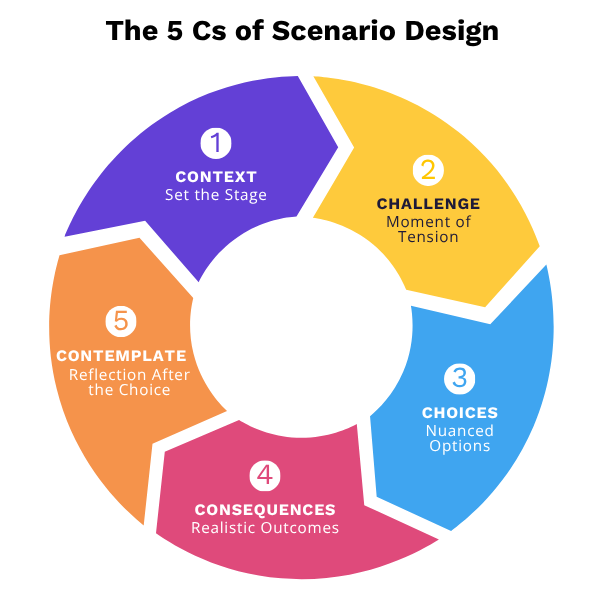
Together, the 5 Cs turn a simple story into a real learning experience.
A Practical Process for Building Effective Scenarios
Building a scenario that actually shifts behavior comes down to a handful of decisions:
1. Identify the moments where employees need stronger decision-making
Look for hesitation, inconsistency, or habitual responses that don’t align with expectations.
2. Identify the skills high performers use in those moments
What do your best people do differently? Active listening? Asking a clarifying question? Taking a specific action?
3. Gather real stories from across the organization
Talk to supervisors, high performers, and frontline staff. Real examples make scenarios feel authentic and relevant.
4. Build short scenarios that reflect common challenges
Start small. A single decision point is enough to spark insight. Use the 5 Cs to structure the moment, similar to how a smaller refinement to an existing scenario can sharpen it without a full rebuild.
5. Incorporate scenarios into coaching, workshops, and digital learning
Scenarios don’t have to live only in eLearning. They can strengthen onboarding, leadership development, team meetings, and one-on-one coaching, the same range of settings where scenario-based learning outperforms traditional training more broadly.
6. Use feedback to reinforce best practices and encourage reflection
After learners make a choice, help them think through the consequences. Reflection is where judgment develops.
This process doesn’t require more development time, just more intentionality up front.
Final Thoughts
Scenario design is a craft, one piece of the larger process of building effective eLearning, and teams may need support as they learn to build scenarios that are instructionally sound and aligned with real performance needs. That shift doesn’t have to be overwhelming. A single micro-scenario can begin changing a training culture. The goal isn’t cinematic branching experiences. It’s helping employees think more clearly, decide more confidently, and perform more consistently.
Ready to build your first scenario around a real performance gap? Explore our instructional design consulting services or schedule a free consultation with one of our designers to talk through where scenarios could help most.