
The Two Question Approach to Training Needs Analysis
Using curiosity instead of assumptions to build training that works
| September 3, 2026 | Discovery and Analysis, Instructional Design |

In this article:
Imagine spending months building a training program only to discover that employees still make the same mistakes afterward. It happens more often than most organizations realize. Not because the training was poorly designed, but because it focuses on the wrong problem. Training becomes more effective when it starts by understanding what great work looks like and the skill gaps that make it hard for employees to get there.
Key Takeaways
- A Training Needs Analysis helps teams understand what employees need to do differently before building anything.
- Asking better questions early prevents wasted time, dense content, and training that feels disconnected from real work.
- Knowing what great performance looks like shows what training needs to teach, and knowing where performance breaks down shows where practice should focus.
Why Training Misses the Mark
Training falls short when teams move straight to solutions without first understanding the skills employees need and the barriers that hold them back. Without that insight, training becomes misaligned with the work itself. This lack of direction often results in training that’s:
Too dense
When training starts with a list of everything employees “need to know,” we tend to include every detail. Without a training needs analysis to filter for relevance and importance, the course becomes overloaded with information that overwhelms learners.
Too generic
If we don’t understand what great performance looks like, we default to broad explanations instead of targeted skill-building. The result is training that applies to everyone in theory but helps no one in practice.
Too disconnected from real workflows
Without observing the work or talking to frontline staff, training is built around how leaders think the process should work, not how it actually works. Learners struggle to apply what they learned because it doesn’t match their day-to-day reality.
Too focused on information instead of performance
Skipping analysis means teaching what’s easy to explain rather than what’s essential to do. Training becomes a knowledge dump instead of a skill-building experience that helps employees handle real challenges.
A training needs analysis prevents these issues by grounding the work in evidence instead of assumptions.
Training Needs Analysis Starts With Two Powerful Questions
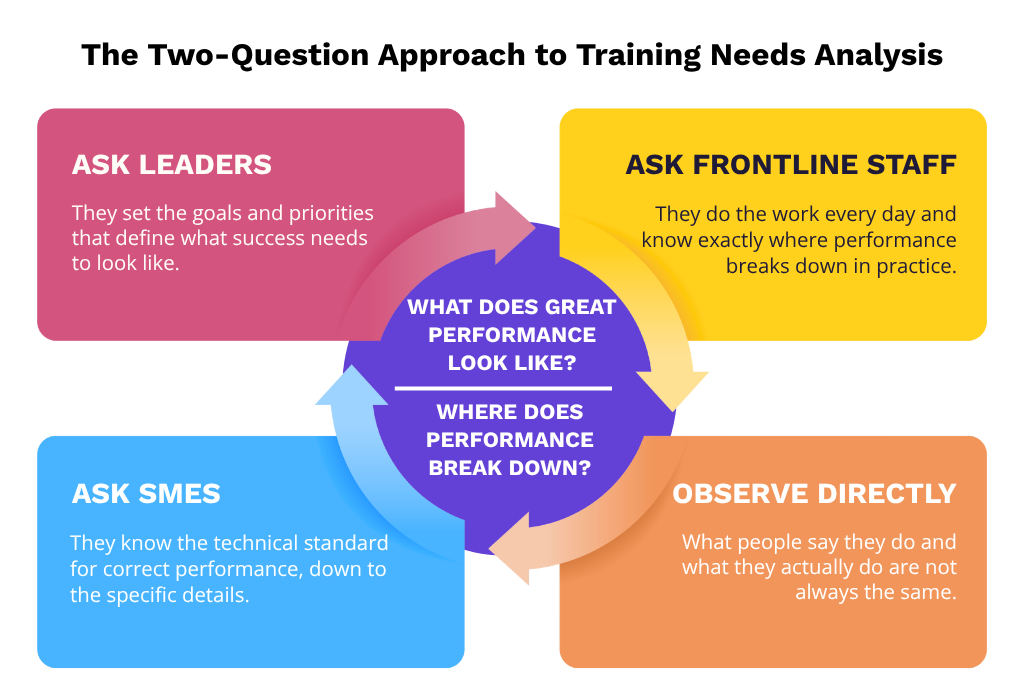
Effective training starts with two questions most teams skip entirely: what does great performance actually look like, and where does it usually break down? Answering both well is the first real decision in the instructional design process. Everything downstream: content, delivery, and measurement, depends on getting it right.
1. What does great performance look like?
This question anchors the entire training program. It shifts the conversation from “topics to cover” to “behaviors to build.” It prevents bloated content and keeps training tightly aligned with real work, the same territory covered by broader research on what drives strong performance at work.
Ask leaders:
“What does success look like in this role? What behaviors matter most?” Leaders help define expectations, outcomes, and the bigger picture.
Ask SMEs:
“What does someone need to do (not just know) to perform well?” Turning SME expertise into training content requires capturing the technical, procedural, and judgment-based elements of the work, not just the facts a learner is supposed to know.
Ask frontline staff:
“When you feel like you’re doing your best work, what does that look like?” Employees reveal the lived reality and provide nuances that leaders don’t always see.
Observe the work:
Watch high performers. Notice how they communicate, navigate tools, make decisions, and recover from mistakes. This is where you uncover the subtle behaviors that training should reinforce.
2. Where does performance usually break down?
Understanding what good performance looks like provides a clear map of the behaviors training needs to support. Getting clarity on the skills learners struggle with most adds direction, showing where training can make the biggest difference, the same instinct behind techniques like the 5 Whys, which push past the first, surface-level answer to find the real root cause. Together, these insights clarify the skills learners need to practice and reveal the decisions they need to rehearse to build real confidence on the job.
Ask leaders:
“Where do you see mistakes, delays, or inconsistencies?” Leaders highlight patterns across teams and identify the moments that matter.
Ask SMEs:
“Where do people typically struggle when they’re learning this task?” Strong collaboration between SMEs and IDs is the best way to uncover common errors, misconceptions, and decision points that should be covered in training.
Ask frontline staff:
“What parts of the workflow feel confusing, overwhelming, or unclear?” Employees surface the friction points. These are the places where training can make the biggest impact.
Observe the work:
Notice when employees hesitate or move away from the behaviors that define great performance. These moments often highlight challenges they don’t bring up in interviews because they’ve normalized them over time.
Final Thoughts
Training is one of the most powerful tools an organization has, but only when it’s built with intention. Instead of seeing a training needs analysis as a delay, organizations should view it as the foundation that ensures the training they create is effective.
Ready to figure out what your team needs before you build another course? Explore our instructional design consulting services or schedule a free consultation with one of our designers to map out your own training needs analysis.