
Working With Subject Matter Experts: Turning Expertise into Training Content
Turning deep SME expertise into skills learners can actually use
| September 9, 2026 | Instructional Design, SME Collaboration |

In this article:
Working with subject matter experts is equal parts energizing and overwhelming. SMEs carry deep, intuitive knowledge, but that expertise rarely arrives in a neat, teachable package. Instructional designers (IDs) sit in the middle of that complexity. They are the translators responsible for turning raw expertise into learning experiences that build capability. That work becomes dramatically easier when IDs bring a thoughtful set of practices to the partnership.
Key Takeaways
- Effective SME collaboration requires shifting the conversation from what experts know to what learners must do.
- Mapping workflows and surfacing tacit knowledge reveals the real work learners need to master.
- IDs create better training when they treat SME partnership as a structured, strategic process rather than an information dump.
Collaboration in Stages
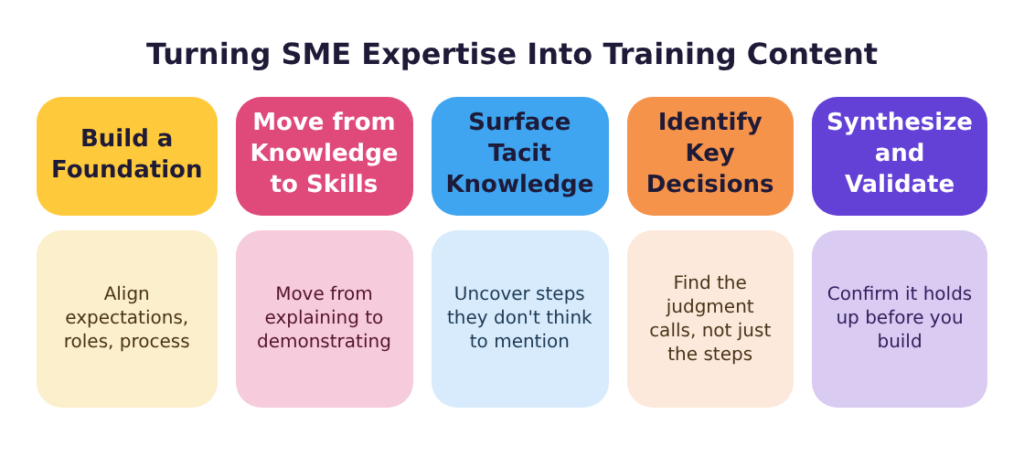
Most SME partnerships don’t fail from a lack of expertise on either side — they fail from treating a series of conversations as one long information dump instead of a structured process with its own logic. Treating SME collaboration as a sequence rather than a single conversation is what turns raw expertise into something a learner can actually use.
Start with the Foundation
Before you begin gathering information from the SME, it’s helpful to lay some groundwork. That includes aligning expectations about working styles, the end product that you expect to create, and the type of information you need to gather. That end product might be a live workshop, a job aid, or a full eLearning build, and naming it early keeps the rest of the conversation grounded. When you make it a priority to establish a framework for your time together, things go more smoothly for everyone involved.
Action Items
- Ask the SME how they prefer to work. For example, whether they want long working sessions or shorter, more frequent meetings.
- Clarify roles by explicitly stating that the SME will provide raw expertise while the instructional designer will shape that expertise into a structured learning experience.
- Provide a simple, jargon‑free overview of the instructional design process and adult learning principles so the SME understands why you may reorganize or simplify their content later.
- Share examples of high‑quality training programs to help the SME visualize the type of final product you are working toward.
- Review the training needs analysis together to establish shared goals and ensure both parties are aligned on the purpose of the training.
Shift from Knowledge to Skills
A common challenge in SME collaboration is the instinct to talk about what you know instead of what learners need to do. Experts naturally talk about what they know. Learners need to understand what they must do. This mismatch is the root of many ineffective trainings. When you anchor the conversation in performance rather than information SMEs begin filtering their expertise through a different lens.
Action Items
- Ask the SME directly: “What should the learner be able to do as a result of this training?” to anchor the conversation in performance.
- Reframe knowledge-heavy statements by translating them into skill-based outcomes and confirming the SME agrees with the shift.
- Use the “10‑minute rule” by asking: “If you only had 10 minutes with a new hire, what would you teach them first?” to help the SME prioritize essential skills.
- Redirect conversations back to performance outcomes whenever the discussion drifts toward excessive detail or background information.
- Summarize the emerging skill list and ask the SME to confirm or refine it so you both agree on the core capabilities learners must build.
Map the Workflow
Most roles have a natural rhythm. There is a sequence of actions, decisions, and transitions that shape the workday. SMEs often skip steps because they’ve internalized them. New learners, however, need structure. Mapping the workflow helps you uncover where people get stuck and where training can make the biggest impact.
Action Items
- Ask the SME to walk through a typical day or process step‑by‑step, capturing each action in the order it naturally occurs.
- Use prompts such as “What happens first, and why?” to uncover the logic behind the workflow and reveal hidden steps.
- Identify friction points by asking: “Where do new employees usually get stuck?” and document these areas for future practice activities.
- Capture transitions by asking: “What signals that it’s time to move to the next step?” so learners understand how tasks connect.
- Compare the SME’s description of the workflow with any documented procedures to identify gaps between the official process and the lived reality.
Surface Tacit Knowledge
Tacit knowledge is the hardest part of SME collaboration, and also the most valuable. It’s the instinctive judgment, the subtle cues, the “you’ll know it when you see it” moments that define true expertise. SMEs often struggle to articulate this because they don’t consciously think about it. Your job is to help them externalize what they normally do automatically.
Action Items
- Ask the SME to perform a task while narrating their thought process aloud so you can capture the intuitive decisions they normally make automatically.
- Request examples of good, bad, and almost‑right work to reveal the subtle distinctions experts use to judge quality.
- Explore common mistakes by asking: “What goes wrong for new hires?” and document the patterns that lead to errors.
- Ask: “What do experienced employees notice that beginners often miss?” to uncover the cues and signals that guide expert judgment.
- Capture the mental models and shortcuts the SME uses so you can translate them into teachable guidance for learners.
Identify Key Decisions
Every role has a handful of decisions that separate competent performance from expert performance. These decisions are often the true backbone of training. When you understand the decisions learners must make, you can design scenario-based learning, practice activities, and assessments that build judgment rather than memorization.
Action Items
- Ask the SME: “What decisions does someone in this role make on a daily basis?” to identify the judgment points that matter most.
- Explore decision quality by asking: “What makes a good decision versus a poor one?” and document the criteria experts use.
- Identify the inputs learners should rely on by asking: “What information should someone use to make this decision correctly?”
- Capture consequences by asking: “What happens if someone chooses incorrectly?” so learners understand the stakes.
- Use these decisions to design realistic scenarios and assessments that build judgment rather than memorization.
Explore Variations
Work rarely follows the ideal path. Course correcting when things go wrong is where real expertise shows up. This is also where learners often feel the most anxiety. Exploring variations helps you design training that prepares learners for the messy, real-world situations they’ll face.
Action Items
- Ask: “What happens when the process doesn’t go as planned?” to uncover the exceptions learners must be prepared to handle.
- Explore unusual situations by asking: “What rare or unexpected scenarios come up in this role?” and document how experts respond.
- Capture adaptations by asking: “How do experienced employees course‑correct when something goes wrong?” to reveal expert problem‑solving strategies.
- Identify risks by asking: “What could go wrong at this step?” so you can design training that prepares learners for real-world challenges.
- Use these variations to create branching scenarios or decision-based practice activities that mirror the complexity of the job. (internal link opportunity: a future post on branching scenario design, not yet published)
Synthesize and Validate
As you wrap up your work with the SME, it’s essential to synthesize and validate what you’ve learned to ensure you’ve got the information you need. This includes reflecting back what they’ve shared and giving them a chance to refine, correct, or deepen the picture before you begin designing.
Action Items
- Ask the SME to clarify any areas where your understanding feels incomplete or where the workflow seems ambiguous.
- Summarize the workflow in your own words and ask the SME to confirm or correct your understanding.
- Validate the skill list by saying: “It sounds like the core skills are X, Y, and Z – does that feel accurate?”
- Ask the SME: “Is there anything else I should have asked you about but didn’t?” to give them space to surface insights, exceptions, or concerns that didn’t emerge during structured questioning.
- Document the full set of insights in a structured outline and share it with the SME for final review before you begin designing the training.
Final Thoughts
Knowing how to effectively work with subject matter experts is a key skill for instructional designers. By asking the right questions and pulling out the most important information, IDs can help organizations turn the wealth of knowledge that SMEs hold into actionable, impactful learning opportunities for their employees.
Ready to make your subject matter expertise more accessible? Explore our instructional design consulting services, or schedule a free consultation with one of our designers to see how we can level up your training.