
The Essential Models for Measuring Training Effectiveness
A practitioner’s guide to the eight frameworks that turn training data into real answers
| September 24, 2026 | Measurement Models and Frameworks, Training Measurement and Evaluation |

In this article:
Most learning teams measure training with good intentions but fuzzy frameworks. They collect surveys, run quizzes, and track completion rates, yet still struggle to answer the question leaders care about most: Did the training make a difference?
Evaluation models give structure to that question. They turn scattered data points into a coherent story about what changed, why it changed, and whether the investment was worth it. When you choose the right model, measurement stops feeling like an administrative chore and starts becoming a strategic advantage.
Key Takeaways
- Eight established evaluation models give L&D teams a structured way to measure training impact, rather than relying on scattered metrics.
- Different models suit different needs: Kirkpatrick for a balanced baseline, Phillips for ROI, LTEM for depth, and others for more specific priorities like strategic alignment or social impact.
- Combining models, rather than picking just one, often gives the clearest picture of whether training worked.
Choosing the Right Lens
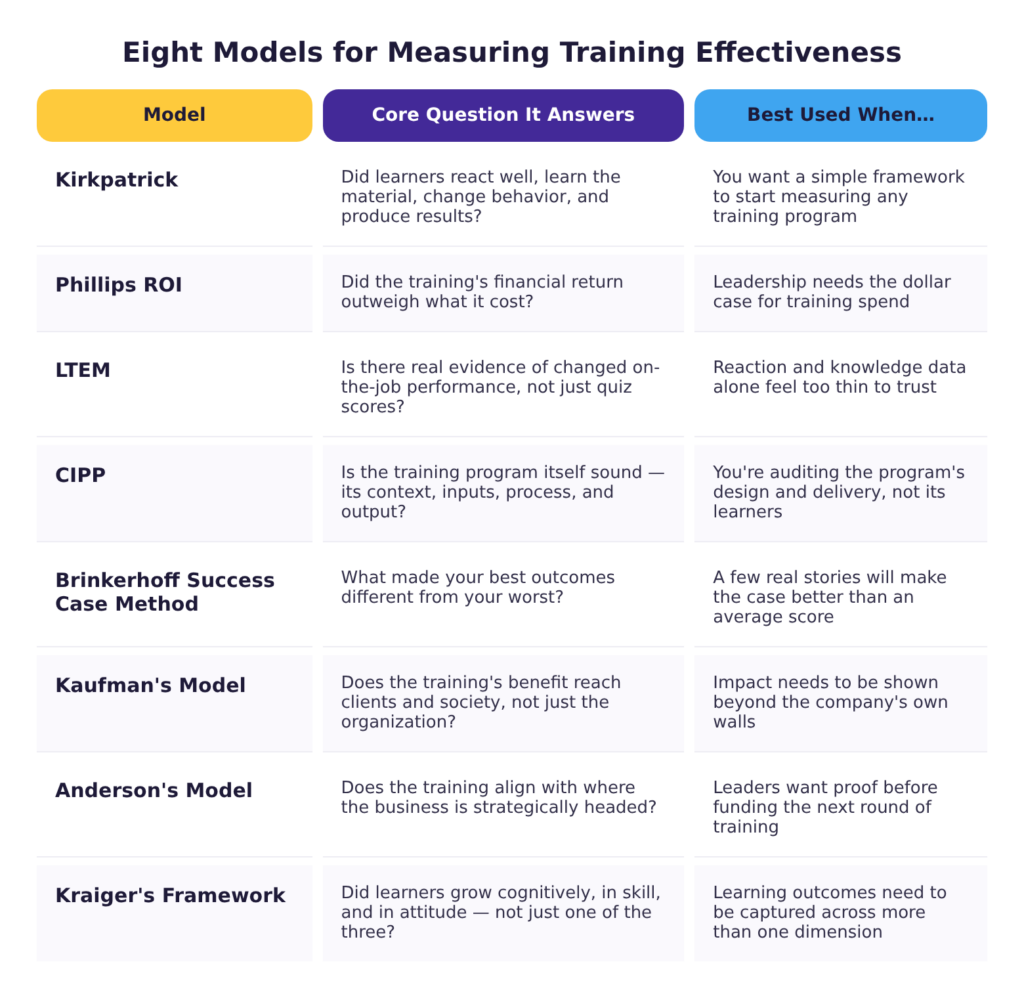
No single evaluation model captures everything leadership wants to know about a training initiative. Kirkpatrick answers a different question than Phillips does, and neither answers what LTEM asks. The real skill isn’t memorizing eight frameworks — it’s recognizing which question you’re actually trying to answer before you pick one.
The Kirkpatrick Model
Kirkpatrick is the classic starting point for training evaluation because it’s intuitive and widely adopted. It moves from surface‑level reactions to deeper indicators of behavior and results, giving L&D teams a simple way to trace learning from the classroom to the workplace.
The four levels:
- Reaction: How learners felt about the training.
- Learning: What knowledge or skills they gained.
- Behavior: Whether they applied those skills on the job.
- Results: The business outcomes influenced by the training.
Kirkpatrick works best when you need a balanced, holistic view, not too complex and not too shallow, though most of what goes wrong with it happens at the Behavior and Results levels, where teams tend to stop measuring right when the interesting data starts.
The Phillips ROI Model
Phillips builds directly on Kirkpatrick by adding the one thing executives always ask for: financial return. It’s designed for organizations that need to justify training budgets or demonstrate the monetary value of learning initiatives. A Return on Investment (ROI) Calculation converts training benefits into financial terms. The formula is:
ROI = Net Benefits ÷ Program Costs × 100
This model is especially powerful when training is tied to measurable business outcomes like reduced errors, increased sales, or improved efficiency.
The Learning Transfer Evaluation Model (LTEM)
LTEM is the modern answer to “vanity metrics.” Instead of stopping at attendance or satisfaction, it pushes evaluators to measure what truly matters: competence, decision‑making, and real‑world performance. The eight tiers are:
- Attendance
- Activity Participation
- Learner Perceptions
- Knowledge Retention
- Decision‑Making Competence
- Task Competence
- Transfer to the Workplace
- Impact of Transfer
LTEM is ideal for organizations that want depth: not just proof that learning happened, but evidence that it stuck and showed up in the work.
The CIPP Model (Context, Input, Process, Product)
CIPP comes from a different lineage than most of the models on this list. Developed for evaluating educational and social programs, it’s less concerned with whether a single training event worked and more concerned with whether the process that built it was sound. The four components are:
- Context: What problem the training is meant to solve.
- Input: The strategy, resources, and design choices.
- Process: How well the training was implemented.
- Product: The outcomes and impact.
CIPP is especially useful for complex or long‑term programs where success depends on organizational alignment, design quality, and execution. Translated into a corporate setting, it’s less a tool for judging one course and more a tool for improving how your team builds the next one.
The Success Case Method (SCM)
SCM offers something the other models don’t: a focus on extremes. It identifies the most successful and least successful instances of training application and analyzes what made the difference. SCM looks for:
- Where training worked exceptionally well
- Where it failed to produce results
- What conditions influenced those outcomes
SCM is practical, fast, and deeply human. It helps organizations understand the real‑world factors that accelerate or block learning transfer.
Kaufman’s Five Levels of Evaluation
Kaufman expands traditional evaluation by adding an external lens. While it includes familiar elements like reaction and learning, it ultimately asks a bigger question: how does this training benefit the people the organization serves, and the world beyond it? The five levels are:
- Inputs & Process: The quality and efficiency of the resources and methods used.
- Reaction: Learners’ satisfaction and engagement.
- Learning: The knowledge and skills gained.
- Performance: How well learners apply new skills and contribute to organizational goals.
- Societal Impact: The broader value created for clients, communities, or external stakeholders.
Kaufman is especially relevant for organizations with strong commitments to social responsibility, public impact, or community outcomes.
Anderson’s Model of Learning Evaluation
Anderson’s model takes a strategic, business‑aligned approach. Instead of evaluating training only after delivery, it begins by defining the value the organization expects the training to create, then measures against that expectation. The core stages are:
- Strategic Alignment: Identify the business goals the training must support.
- Solution Identification: Determine whether training is the right solution and which modality will deliver the most value.
- Value Forecasting: Estimate the expected performance and financial impact before development begins.
- Impact Measurement: Evaluate the program’s actual contribution to the predefined business metrics.
Anderson’s model is ideal for organizations that want to ensure learning investments are tightly connected to strategic priorities and measurable business value.
Kraiger’s Three‑Dimensional Framework
Kraiger’s model brings academic rigor to evaluation by focusing on what type of learning occurred, not just whether learning happened. It categorizes outcomes into three dimensions, echoing the cognitive, skill-based, and affective domains found in Bloom’s Taxonomy, allowing L&D teams to design assessments that directly match the training’s goals. The three dimensions are:
- Cognitive Outcomes: What learners know, from basic recall to complex mental models.
- Skill‑Based Outcomes: What learners can do, measured through performance, demonstrations, or task execution.
- Affective Outcomes: How learners feel, including attitudes, motivation, and confidence.
Kraiger’s framework is especially valuable for programs where success requires a blend of knowledge, practical skill, and mindset shifts.
Final Thoughts
Combining models, rather than relying on just one, is where the real power comes from and is worth building into your own instructional design process from the start. Many organizations use Kirkpatrick as a baseline, LTEM for deeper insight when measuring training effectiveness beyond completion rates, and Phillips or Anderson when ROI or business alignment matters, all folded into a structured measurement plan.
Ready to figure out which measurement models fit your training goals? Explore our instructional design consulting services or schedule a free consultation with one of our designers to build out an evaluation approach that works for your organization.