
How to Measure Training Effectiveness (Beyond Completion Rates)
Completion rates show who finished, not what changed
| September 22, 2026 | Measurement Models and Frameworks, Training Measurement and Evaluation |

In this article:
Completion rates are one of the most commonly reported training metrics, and one of the least useful. They tell you who showed up, not who changed. They reveal attendance, not impact. And yet, many organizations still rely on them as their primary indicator of success.
If training is going to matter, measurement has to look at what happens after the module closes: what learners retain, how they apply new skills, and whether performance improves in ways that move the business forward. That requires a more progressive, layered approach to evaluation, one that goes far beyond “Did they finish?”
Key Takeaways
- Completion rates measure attendance, not whether training changed anything.
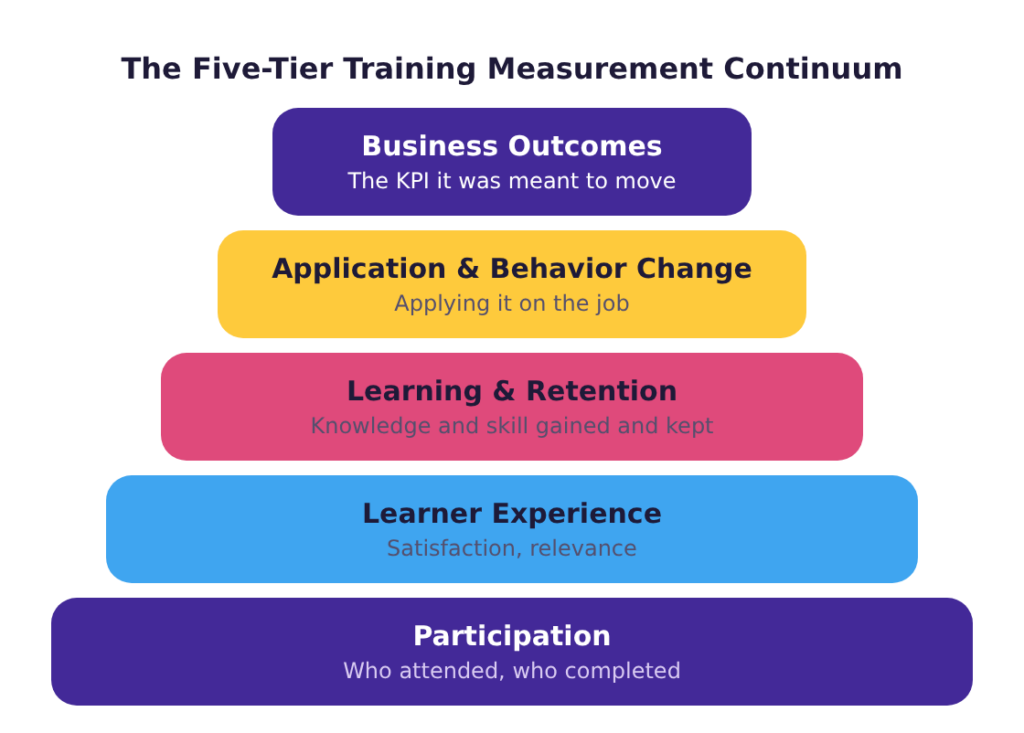
- Training effectiveness is better understood as a continuum of five tiers, from participation through business outcomes, not a single data point.
- Pairing the right measurement method with the right tier makes evaluation more precise and more actionable.
The Measurement Continuum
Training effectiveness is a progression, not a single data point, and five levels of evaluation capture that progression well. Each tier reveals something different about how learning shows up in the workplace.
Tier 1: Participation
This is the most basic level: who attended, who completed, and how long they engaged. It’s useful for operational tracking, but it doesn’t tell you whether learning occurred.
Tier 2: Learner Experience
Here, the focus shifts to how learners perceived the training. Was it relevant? Clear? Useful? Did they believe it would help them perform better? These insights help you understand whether the training resonated, but they still don’t confirm behavior change.
Tier 3: Learning & Retention
This tier measures what learners absorbed. It includes recall of facts, understanding of concepts, and the ability to make decisions based on new knowledge. It’s the first point in the continuum where you can begin to see whether the training achieved its instructional goals.
Tier 4: Application & Behavior Change
This is where training becomes real. Are employees using the skills on the job? Are managers seeing changes in behavior? Are new habits forming? This tier reveals whether learning transferred into day‑to‑day work.
Tier 5: Performance & Business Outcomes
The highest tier connects training to measurable improvements in performance and organizational results. This is where you see whether training influenced KPIs like productivity, accuracy, customer satisfaction, sales, or efficiency.
When the instructional design process builds in methods to measure across multiple tiers, you gain a clearer, more honest picture of whether training is making a difference. Knowing the tiers is only half the plan, though; the other half is choosing the right method to capture each one.
Methods That Support Each Tier
Different tiers require different evaluation methods. When you pair the right method with the right tier, measurement becomes more precise and more actionable.
Surveys
Surveys are most effective at the learner‑experience tier, but they can also support long‑term evaluation when used strategically. Immediate surveys capture relevance and clarity. Delayed surveys reveal whether learners applied what they learned.
Quizzes & Assessments
Assessments help measure learning and retention. They work best when they go beyond simple recall and instead test decision‑making, problem‑solving, or scenario‑based judgment. Short‑term quizzes show immediate understanding; delayed assessments reveal long‑term retention.
Observational Assessments
Observation is one of the most powerful ways to measure behavior change. Structured checklists help managers look for specific behaviors tied to the training. When observers are calibrated, the data becomes reliable and actionable.
Skill Application Metrics
These metrics track whether employees are using new skills and whether those skills are improving performance. They might include error rates, task accuracy, productivity measures, or customer feedback. When baseline data is collected before training, these metrics become especially meaningful.
Performance & Business KPIs
This is where training connects to organizational outcomes, the same KPIs that should already be part of how the measurement plan was built in the first place. Pre‑ and post‑training comparisons reveal whether the training influenced key metrics. Long‑term trends show whether improvements are sustained.
When these methods are used together, they create a multi‑layered picture of training effectiveness, one that goes far beyond attendance.
Final Thoughts
Completion rates will always have a place in training dashboards, but they should never be the whole story. Relying on them alone is one of the most common mistakes in measuring training effectiveness. The most valuable training metrics include what learners remember, how they behave, and how their performance changes over time. When you measure training across multiple tiers, you gain the insight needed to design learning experiences that truly support the skills that matter.
Ready to see how your training measures up beyond completion rates? Explore our instructional design consulting services or schedule a free consultation with one of our designers to build out your own measurement approach.