
How to Build a Training Measurement Plan
Good measurement starts with clear goals, not a scramble for data afterward
| September 18, 2026 | Measurement Strategy and Planning, Training Measurement and Evaluation |

In this article:
Learning teams collect more training data than ever before, yet many still struggle to connect it to a real outcome. Completion reports, learner surveys, quiz scores, and LMS dashboards all provide useful information, but on their own they don’t explain whether training changed behavior or improved business performance. Without a clear strategy, measurement becomes a collection of disconnected metrics rather than meaningful evidence.
Key Takeaways
- Effective measurement begins before training with a clear definition of the business problem and the behaviors that need to change.
- Looking beyond completion rates and satisfaction surveys provides a more complete picture of learning effectiveness.
- A structured measurement plan helps learning teams demonstrate impact, identify opportunities for improvement, and make better decisions about future training.
Building the Plan, Step by Step
A measurement plan lives or dies on its first decision: what problem it’s solving. That choice determines what counts as evidence, which metrics matter, and what the results are ultimately for. Naming the problem badly or skipping it entirely is why so many measurement efforts end up with data that doesn’t answer anything leadership actually asked.
Start With the Performance Problem
The best training initiatives and the best measurement plans begin with the same question:
What should people do differently after completing this training?
That question shifts the conversation away from content and toward performance. Before selecting metrics or creating assessments, identify the business challenge the training is meant to solve, the behaviors employees need to demonstrate as a result, and the specific knowledge and skills required to perform those behaviors consistently.
This upfront alignment keeps the entire measurement strategy focused on meaningful outcomes instead of generic learning metrics. Once the problem is defined, the next step is deciding what to measure.
Build a Training Measurement Plan Around Five Levels of Evaluation
Not every training initiative requires the same type of evaluation. The goal is to collect the data that tells you whether the training achieved its purpose, not simply as much data as possible. A comprehensive measurement plan typically looks at five levels of evaluation.
Participation
Participation tells you who completed the training. It’s useful for tracking compliance or attendance, but completion alone doesn’t tell you whether anyone learned or applied anything.
Learner Experience
Learner feedback helps you understand how participants perceived the training. It can uncover issues with pacing, facilitation, or usability, but positive reactions don’t necessarily translate into improved performance.
Learning and Retention
Knowledge checks, scenario-based assessments, and quizzes measure what learners understood and remembered. They provide evidence that learning occurred, but remembering information isn’t the same as applying it on the job.
Behavior and Application
This is where measurement becomes significantly more valuable. Are employees using the new skills in their day-to-day work? Manager observations, coaching conversations, workflow audits, and performance reviews often provide the clearest evidence of behavior change.
Business Performance
Ultimately, training exists to improve the KPIs your organization already tracks: higher customer satisfaction, fewer quality errors, faster task completion, increased sales, improved safety performance, or reduced support tickets, depending on what the initiative was built to move.
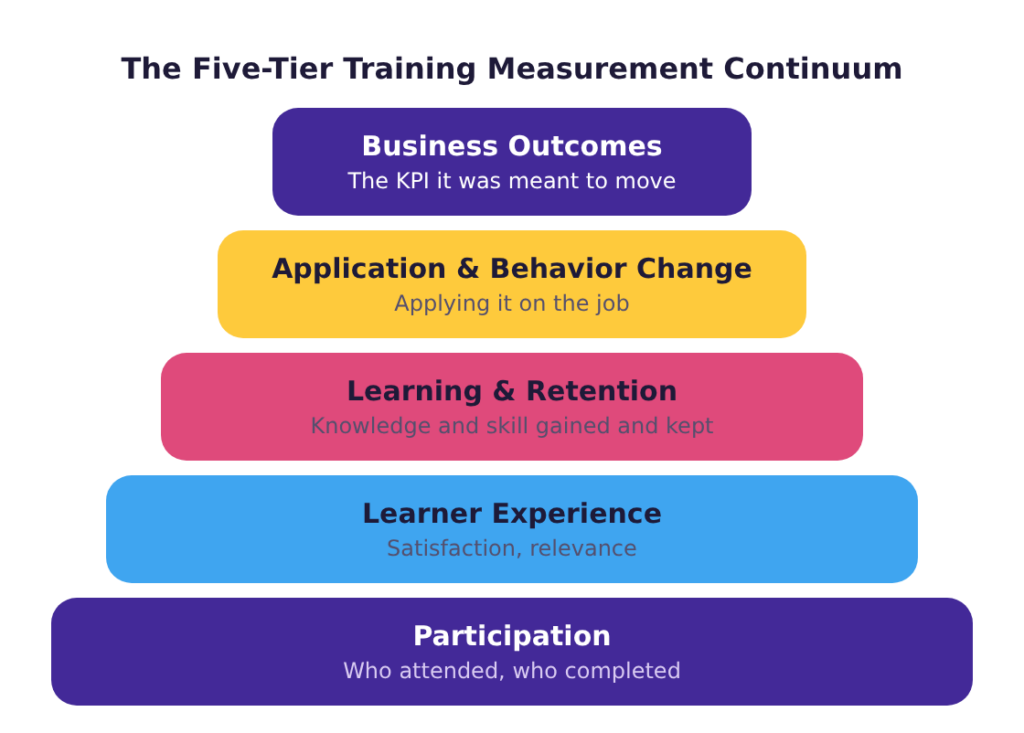
Connecting improvements in these metrics back to the specific behaviors training was designed to influence is what separates a real business case from a coincidence. With these five levels in mind, the next question is how you’ll collect evidence at each one.
Choose Training Evaluation Methods That Match Your Goals
Once you’ve identified what you want to measure, choose methods that provide reliable evidence — different tools answer different questions, and the wrong one just produces more data that doesn’t say much.
Surveys and interviews are the right call for learner experience, since perception is something only the learner can report. Knowledge and decision-making need something more active: quizzes, assessments, and scenario-based activities that ask someone to apply what they learned rather than just recall it.
Behavior change is harder to capture on paper, and shows up instead in manager observations, simulations, and coaching evaluations, where it has to be seen in practice. Productivity metrics, quality scores, error rates, and workflow data measure job performance directly.
Business impact sits a level above all of that: organizational KPIs like customer satisfaction, revenue, or operational efficiency — the numbers a training initiative was ultimately meant to move.
No single method tells the whole story. Surveys can reveal how learners felt about the experience, but they can’t confirm whether new behaviors became part of everyday work. Likewise, a perfect quiz score doesn’t guarantee successful performance on the job. Using multiple methods creates a more complete picture of training effectiveness. Before any of these methods can show real change, though, you need something to measure that change against.
Establish Baseline Performance Metrics
One of the most common mistakes in training measurement is skipping the baseline. Without understanding where performance started, it’s difficult to determine whether training contributed to meaningful improvement.
Baseline data can come from current productivity levels, error rates, customer satisfaction scores, behaviors managers have already observed, employee engagement measures, or quality metrics — whichever ones connect to what the training is targeting. A customer service team whose satisfaction scores move from 82% to 90% after training has a comparison that says far more than a post-training score alone ever could. That’s what a baseline provides: a before-and-after comparison instead of an educated guess. With one in place, the plan can start tracking whether change holds up over time.
Measure Training Effectiveness Over Time
Learning happens during training. Performance improvement happens afterward. New skills need practice, reinforcement, and time before they become consistent habits. That’s why measurement shouldn’t stop when the course ends.
A simple follow-up schedule might include:
- 30 days: Check for early application and identify barriers.
- 60 days: Evaluate consistency and provide coaching where needed.
- 90 days: Review performance metrics and determine whether business outcomes are improving.
These checkpoints help distinguish temporary enthusiasm from lasting behavior change. None of this happens in an L&D vacuum, though, which is why the plan needs input from beyond the training team itself.
Involve the Right Stakeholders
Training measurement isn’t solely an L&D responsibility. Managers, subject matter experts, and business leaders all contribute valuable perspectives.
Managers can observe whether employees are applying new skills. SMEs can validate technical performance. Business leaders can determine whether training is contributing to organizational goals.
Creating regular feedback loops with these groups gives learning teams richer insights than LMS data alone and helps ensure training remains aligned with business priorities. All of this data and input only matters, though, if it changes what the team does next.
Turn Training Metrics Into Better Decisions
Collecting data isn’t the goal. Improving performance is.
Every measurement plan should include a process for reviewing findings and deciding what to do next. The results might point toward updating the training content, simplifying a topic that’s clearly too dense, improving the practice activities, strengthening reinforcement after the course ends, providing targeted coaching, or refining the next learning initiative before it’s built. When measurement drives action like this, every training program becomes a chance to make the next one better.
Final Thoughts
Measuring training effectiveness is one piece of the broader instructional design process. It comes down to collecting the right evidence at the right time and using it to improve performance. The strongest measurement plans don’t simply prove that training happened. They help organizations understand what changed, why it changed, and how to make the next learning initiative even more effective.
A thoughtful measurement plan starts with thoughtful instructional design. Explore our instructional design services to see how we develop learning experiences built for measurable impact, or schedule a free consultation with one of our designers to talk through your training goals.