
Scenario-Based Learning: What It Is and How to Use It
Judgment is built one decision at a time, not handed over as a fact

In this article:
Someone can pass every knowledge check on a topic and still freeze the first time they have to put that knowledge to use on the job. Scenario-based learning exists for that moment — a decision, made under pressure, with a result the learner feels, not a fact to be recalled and forgotten. A new manager sitting down for a hard performance conversation, a support agent facing an already-frustrated customer, a caseworker meeting a client who doesn’t want to be there: none of them got ready for that by passing a knowledge check.
Key Takeaways
- Scenario-based learning covers a spectrum of techniques, from a single decision point to a branching path to a full simulation, matched to how much judgment a skill requires.
- The format works by pairing a choice with a consequence the learner experiences, not a right-or-wrong answer scored after the fact.
- A handful of concrete questions, rather than a general instinct that “interactive is better,” determine whether a topic belongs in a scenario at all.
How Scenario Based Learning Works
A well-built scenario does something a knowledge check can’t. While a multiple-choice question asks a learner to recognize the right approach, a well-built scenario asks them to use it and see what happens as a result.
Take the example of a training program that needs to teach mental health professionals how to build enough rapport with a new, resistant client that the therapeutic relationship can move forward. The scenario puts the learner across from a client meeting them for the first time and gives them a handful of realistic ways to respond. Choose well, and the client opens up enough to keep going. Choose poorly, and the client shuts down and disengages, forcing the learner to start the interaction over. That’s a different kind of feedback than a screen marking an answer right or wrong — the learner feels the client’s reaction happen in real time, the way an actual clinician would feel a session go sideways in the room.
That’s the real case for scenario-based learning over a traditional course: a course can teach someone to recognize the right move, but only a scenario forces them to make it under pressure, the way they’ll have to when they’re back on the job.
Scenario Based Learning is a Spectrum of Techniques
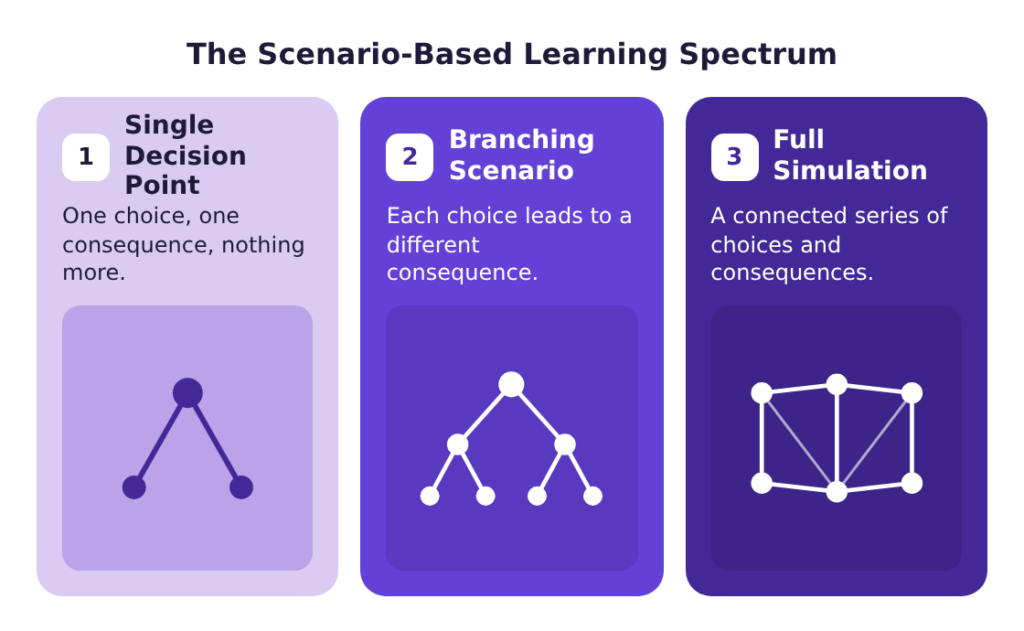
Where a topic lands on the scenario-based learning spectrum depends on how much judgment the skill calls for. What holds every point on that spectrum together is the same mechanism: a learner makes a choice, and the choice produces a consequence they experience rather than a grade they’re handed. That’s the same principle Kolb’s Experiential Learning Cycle describes directly: people learn more from doing something and living with the result than from being told what the result would be. There’s a motivational piece too: a genuine choice, not a forced one, taps into autonomy as a driver of motivation, something research on self-determination has documented for decades. People engage more with a decision they made than with a path they were walked through.
A single-decision scenario is the leanest version: one situation, a small set of response options, and feedback on what happened next. It fits a skill that comes down to one judgment call in the moment (noticing a safety hazard on a job site and choosing the right immediate response). It’s fast to build and easy to keep current, though it only shows a learner one moment, not how a decision plays out over time.
A branching scenario adds consequence over time: each choice doesn’t just resolve, it changes which situation comes next, so a poor early choice can make the rest of the process more difficult (a support call that gets harder to salvage the longer a rep talks past a customer’s frustration). That structure is powerful, but it multiplies fast on the build side: a scenario with even three decision points and three options each has to account for dozens of paths. For the learner, the challenge is different. They only see the path their own choices create, but the further into it they get, the more they have to hold in mind: everything that’s already gone right or wrong, stacking under whatever they decide next. Managing that comes down to how much a learner can hold in mind at once, not how clever the branching gets, and it’s often a matter of a few strategic decisions during the build.
At the far end is a full simulation: a complete process, walked through step by step, with consequences that compound the way they would in the real environment (a machine operator walking through a full equipment shutdown sequence, where skipping one step early causes a failure three steps later). Simulations earn their build cost when a mistake is too costly to risk in real life, and an eLearning environment is where it’s safe to make one instead.
Deciding Where Scenarios Fit
A few questions can help teams determine if their training topic could benefit from a scenario:
- Does the skill involve a real-time judgment call, not just a fact to recall? A conversation, a triage decision, a customer interaction are usually a “yes”. A policy, a date, a procedure with one correct sequence are usually a “no”.
- Do different choices lead to different results that the learner would notice? If every option leads to roughly the same outcome, the scenario has nothing to teach.
- Does the audience need to practice doing something, not just recognize the right answer among a few choices?
A topic that meets all three criteria is worth the investment in scenario-based learning. A topic that doesn’t is usually better served by a shorter, more direct format.
Final Thoughts
A knowledge check confirms someone can name the right answer, but it doesn’t help them act on it when it counts. Scenario-based learning closes that gap for the skills that matter. Building a scenario that captures a real decision under pressure, rather than a branching quiz with better graphics, is the work an instructional designer is trained to do.
If your team is teaching a skill that comes down to a judgment call, check out our custom eLearning development services or schedule a free consultation with one of our instructional designers to talk through where scenario-based learning would fit in your own training.