
Microlearning for Employee Training: Where It Fits in Your Training Strategy
Learn where microlearning belongs in your training ecosystem, and where it doesn’t
| September 21, 2026 | eLearning Development, Microlearning, Training Formats and Delivery |

In this article:
It’s a familiar scene. An employee opens a required training module, watches the progress bar creep toward “45 minutes remaining,” and mentally checks out somewhere around slide six. They’ll finish it (most people do, if only to make the reminder emails stop), but ask them a week later what it covered and you’ll get a shrug. If you’ve watched this happen on your team and wondered whether the training itself is the problem, you’re asking the right question.
Key Takeaways
- Long, one-time training sessions work against how the brain naturally forgets information, while short, spaced-out modules are built to counter that decline.
- Microlearning centers on one skill, delivered in the moment it’s needed, rather than an entire course compressed into less time.
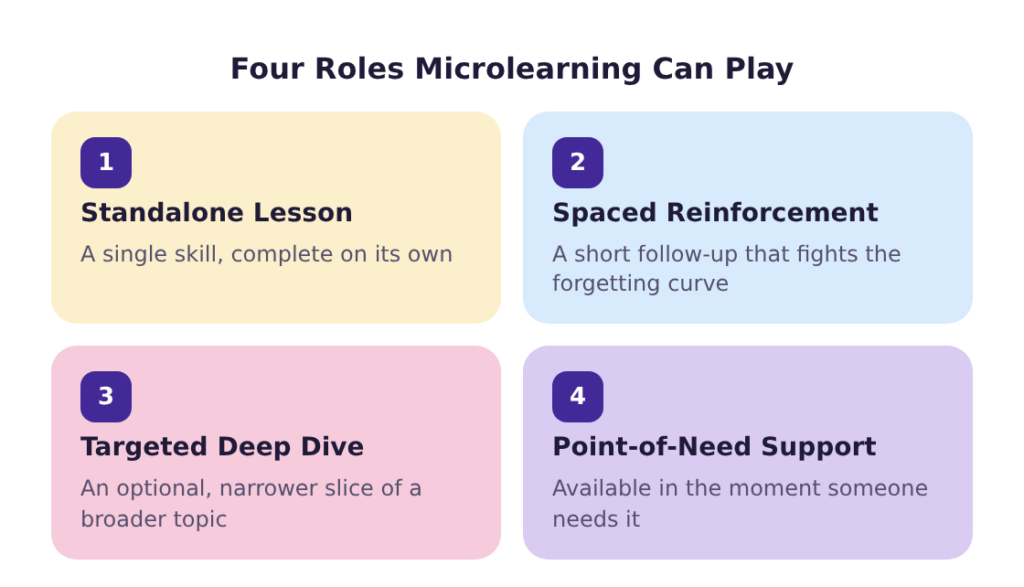
- Microlearning can serve several distinct roles in a training strategy: a standalone lesson, spaced reinforcement, a targeted deep dive, or support delivered right at the point of need.
Using Microlearning for Employee Training
Microlearning is one format inside modern eLearning, alongside synchronous sessions, asynchronous courses, and blended programs. It’s a short, focused unit of training built around a single skill, delivered at the moment someone needs it. You can think of a traditional, longer format course as handing someone a full toolbox and with the expectation that they choose the tool they need at the right time. Microlearning, instead, hands them the exact tool they need, exactly when the job calls for it. In practice, that could look like:
- A software company sending sales reps a two-minute refresher on a key product differentiator a few weeks after onboarding, to improve retention.
- An HR employee pulling up a short refresher on name-change paperwork, a task that only comes up occasionally, right when a request comes in.
- A hospital updating a four-minute module on a new intake procedure the week the protocol changes.
In every case, the module solves one problem, for one person, at the moment it matters, instead of trying to cover everything at once.
Why Shorter Lessons Stick
The case for microlearning holds up against well-established principles of how people learn and forget, not just industry enthusiasm. The instructional design process leans on the same handful of mechanisms when building a microlearning module:
- It fights the forgetting curve. The forgetting curve describes how quickly people lose newly learned information without reinforcement, most of it within days of a single exposure. Instructional designers counter this by breaking content into focused, spaced-out pieces, rather than asking people to retain everything from one long session.
- It shows up when it’s needed. Concepts reinforced by immediate use tend to stick better than ones learned well ahead of when they’re necessary. When possible, instructional designers deploy training as close as possible to the moment someone will use a skill, like the week a new tool rolls out, instead of just scheduling training whenever the calendar has room.
- It works with cognitive load. Cognitive load theory holds that working memory can only process a limited amount of new information at once. Holding a module to one skill keeps it inside that limit and increases the likelihood that learners will retain and apply new knowledge.
- It fits into a day that wasn’t built around training. Most employees are juggling a full schedule, and carving out an uninterrupted hour for training is hard to do and easy to resent. Good design accounts for how people experience their workday, a few minutes between meetings or a break between customers, and builds learning opportunities that fit.
- It’s faster and cheaper to build well. Shorter, tightly scoped modules take less time to produce than a full course and pull people away from their jobs for far less time in the process.
Shorter formats outperform when they’re built with the same rigor as anything longer. That doesn’t mean every training problem is a microlearning problem, though, and knowing where the line sits is the harder judgment call.
Where Microlearning Fits and Where It Doesn’t
Microlearning doesn’t have to be an all-or-nothing choice against a longer course. In practice, it tends to show up in a few different roles:
As the whole solution, when the content really is one discrete thing someone needs to learn in a single sitting. A warehouse team learning a new scanner interface before their next shift doesn’t need a course; they need one focused module covering that one change.
As reinforcement, spaced out after a longer course to fight the forgetting curve. A five-minute refresher a week after a workshop, and another a month after that, keeps a skill from fading.
As a targeted deep dive inside a broader topic. Every manager might take a full course on conducting performance reviews. But only some may want to access a short module on handling a review with an employee on a performance plan, a situational skill that doesn’t come up as frequently.
As point-of-need performance support, available in the moment someone is actually doing the task rather than assigned ahead of time. A technician pulling up a two-minute walk through mid-repair is using microlearning less like training and more like a job aid.
The question isn’t “is this topic a fit for microlearning or not.” It’s “which role could microlearning play here.”
Final Thoughts
Microlearning can be a powerful tool in an organization’s training ecosystem. Whether it’s used to provide employees with a quick skill boost right before a specific task, a focused deep dive that only some people need, or a short refresher a few weeks after a longer course to help it stick, microlearning can be a versatile tool in an evolving training environment.
Ready to explore how microlearning might fit into your training ecosystem? Explore our custom elearning development solutions or schedule a free consultation with one of our designers for tailored recommendations.