
Building a Balanced Workplace Training Program
Why the most effective learning strategies account for more than formal training alone
| September 8, 2026 | Learning Program Strategy, Workplace Learning Strategy |

In this article:
If you watch how people actually learn at work, you’ll notice that most of it happens outside formal training. It shows up in quick conversations, small corrections, shared tips, and the dozens of informal moments that fill a normal day. Yet organizations still pour most of their energy into the most structured, least available part of the mix: push training. A modern learning strategy has to account for all the layers, not just the one that’s easiest to track.
Key Takeaways
- Most workplace learning happens outside of formal training, in coaching, shared knowledge, and everyday problem-solving.
- A balanced training program accounts for six distinct layers, not just the formal courses that are easiest to track and report on.
- Push training has its place, but it can’t carry the entire load of a modern learning strategy on its own.
The Six Layers of a Learning Ecosystem
Most training strategies focus on the layer that’s easiest to see and measure, then wonder why performance doesn’t move the way the completion rates suggest it should. The other five layers are doing more of the actual work, even though they’re the hardest to formalize and report on. In his book, The Modern Learning Ecosystem, JD Dillon outlines six ways employees gain new knowledge and skills that vary in their structure and availability:
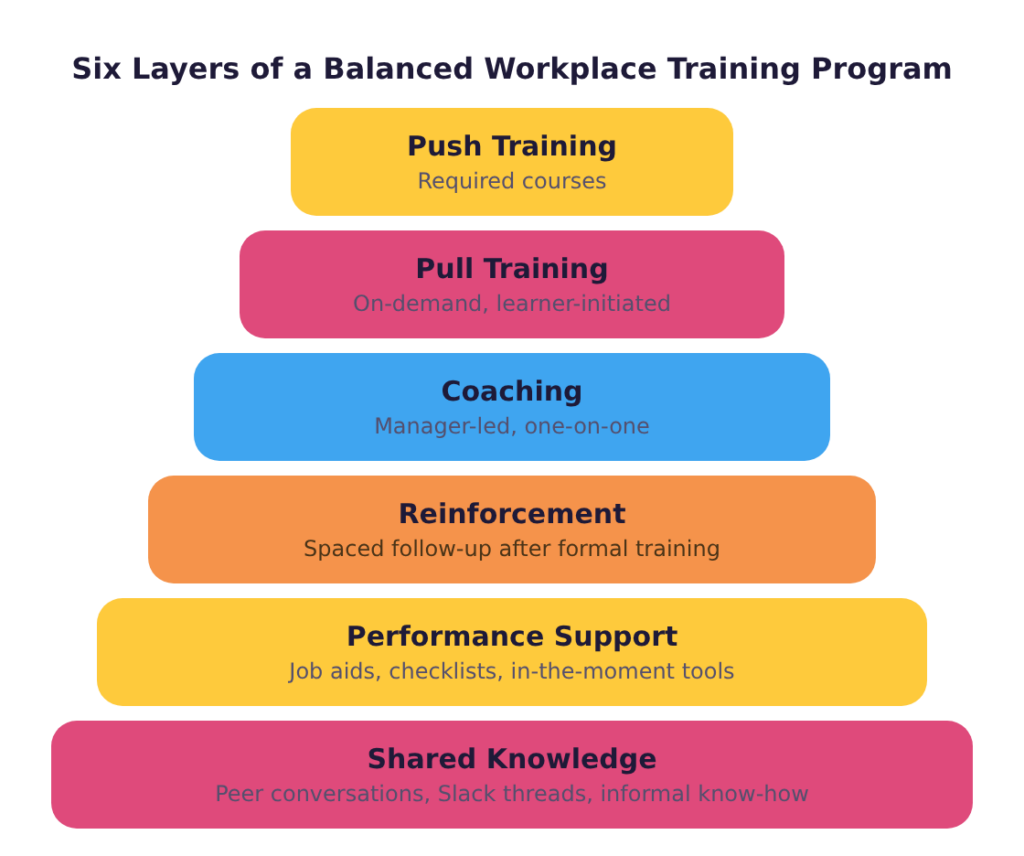
Push Training
Push training is the classic version of workplace learning: compliance modules, required courses, certifications, and anything else employees are assigned. It’s built around explaining concepts rather than helping people build skills, which is part of why it often feels disconnected from real work. Organizations rely on it heavily because it’s predictable and easy to report on, but it’s rarely the thing that helps someone solve a problem in the moment. Treat push training as the foundation, not the whole house. Pair it with practice, coaching, and performance support so people can use what they learned.
Pull Training
Pull training is what people seek out when they need something right now: an on‑demand course, a short video, a microlearning module, or a quick search through a learning library. It’s more aligned with real needs because learners choose it when the timing makes sense. The catch is that pull training only works when people know where to find it and trust that it’s worth their time. Make the good stuff easy to find. One clear entry point and consistent tagging go a long way.
Coaching
Coaching is where some of the most meaningful learning happens: a manager walking someone through a tricky situation, a peer sharing a shortcut, an SME explaining why a process works the way it does. It’s personal and contextual, which makes it incredibly effective. But it’s also uneven. Some managers coach constantly; others barely do it at all. Give managers simple tools and prompts so a real coaching conversation becomes part of the rhythm of work, not something they squeeze in when they remember.
Reinforcement
Reinforcement is the part of learning most organizations forget. People need reminders, practice, and small nudges to help new skills stick. Without reinforcement, even good training fades quickly. A short follow‑up activity or a spaced reminder can make the difference between “I took the course” and “I can actually do this now.” Build reinforcement into the plan from the start instead of treating it as an optional extra.
Performance Support
Performance support is the quiet workhorse of workplace learning: job aids, checklists, quick reference guides, and the little tools people keep open on a second monitor. These resources help employees do their jobs without needing a course at all. When they’re missing, people improvise, or guess. Keep performance support close to the work. If someone has to hunt for it, it’s already too far away.
Shared Knowledge
Shared knowledge is the most abundant layer and the least structured. It’s the Slack thread where someone explains a workaround, the hallway conversation that clears up a confusing process, the informal community of practice that forms around a recurring problem. It’s messy, social, and often the fastest way people learn. Give teams a place to share what they know, somewhere better than a buried chat thread that disappears after a week.
Final Thoughts
When you step back, a pattern becomes obvious: organizations spend most of their energy on push training, even though the layers below it are where most real learning happens. Push training has its place within a broader workplace learning strategy, but it can’t carry the entire load. A modern learning strategy has to support all six layers intentionally; otherwise, the gaps between them become the gaps in performance. Knowing whether that support is actually working takes real measurement, not a hunch — the same mistakes that undermine training measurement generally are just as capable of hiding a gap between layers as they are of hiding a bad course.
Curious whether your own training program covers all six layers? Explore our instructional design consulting services or schedule a free consultation with one of our designers to build a more balanced approach.